
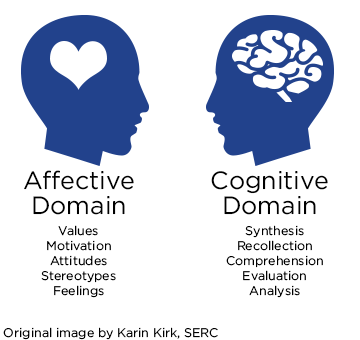
The affective domain deals with attitudes in the classroom and beyond. The basic stages are receiving phenomena, responding to phenomena, valuing, organization and internalizing values. Students move from selected attention (receiving) to active participation (responding), to valuing the worth of a person or object (valuing) to organizing values into priorities by contrasting different values (organizing) and finally to adopting a value system that controls their behavior (internalizing). These steps are very important for the proper development of children and therefore need to be practiced in the classroom and woven into classroom activities such as: creating social plans to improve society, exercising safety rules and displaying appropriate teamwork.
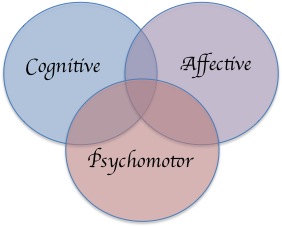
The psychomotor domain are tied to skill based responses with the steps (ranging from lowest to highest): perception, set, guided response, mechanism, complex or overt response, adaptation and origination. This type of learning is demonstrated by physical skills to include both fine and gross motor skills. When students start at the bottom of the taxonomy, they are making observations about a particular task, such as watching someone perform a gymnastics routine and move through the continuum, until they are eventually, through practice, are able to create a new gymnastics routine in the origination stage of the taxonomy. Psychomotor skills are important in the classroom, because these skills also include the ability to use technology, which is a very large theme in the classroom. Psychomotor skills should also be incorporated into lesson in order to incorporate the tactile or kinesthetic learning style into lessons.
The affective and psychomotor domain should be included into the classroom environment in order to cover the knowledge based, attitudinal based and skills based taxonomies in order to create a complete learning experience.

No comments:
Post a Comment