Through this semester I have learned about the various considerations one needs to take when teaching such as: the multiple intelligences theory, Masow's hierarchy of needs, the PDE SAS standards, Pennsylvania common core, Pennsylvania certification requirements and constructing a lesson plan. It has surprised me, how much needs to be taken into consideration when one is planning on educating students. Through the inter-cultural nature of the book The Smartest Kids in the World and How They Got There, I have learned that it is relatively easy, in some states to become a teacher in the United States. This greatly disturbs me because I am a firm believer that teaching is not something that you can just do, it has to be something that you love and have a passion for. It is greatly disturbing that those who may not be "cut out" for teaching still can skirt by and have daily interaction with very impressionable youth.
My blogs focused mainly on foreign language education and how popular educational concepts are utilized in the foreign language classroom. For example: implications of bloom's taxonomy in the foreign language classroom, the issue of homework, common core combined with the ACTFL standards and explicit grammar instruction. There were no noticeable shifts in my writing perspective, as I began the blog writing from the perspective of a teacher and ended the blog writing from the perspective of a teacher.
As a learner, I am very self-motivated, driven and a bit of a perfectionist. This is a good and bad quality to possess as sometimes I cannot control all of the situations that I am placed in. This semester has taught me that I sometimes need to accept my best as my actual best and that I cannot control all of the small details of something. These dispositions have helped me as I complete my school work with no external motivation and always complete assignments to the best of my ability.
As a teacher I will face the challenge of getting my students to believe that German is a subject worth taking. It is not a throw away course and can actually be used in the real world. I can overcome this obstacle by demonstrating the use of German in a real word situation through my lessons and teaching my students cross-cultural skills that can be applied to other countries they may visit in the future.
I remain very committed to teaching, as each education class I take reaffirms my passion for teaching and working with students. I feel that teaching is my calling and am very excited to be working directly with students next semester as a student teacher.
Taking this course has not changed my opinion on teaching. I am very confident that I have chosen the correct major because I enjoy all aspects of teaching: working with students, lesson planning and curriculum. I am very passionate about students and my content area.
As a teacher, I strive to always be advancing my knowledge of my content area, I wish to engage my students and spark their love for foreign language. One of my personal goals is to remain professional in the field and refrain from gossiping, no matter how tempting, as in the end, gossiping is only hurtful to those mentioned and is quite unprofessional. Another professional goal I have is to visit German-speaking countries frequently, in order to keep my information for my students current.
Tübingen Germany

Tuesday, November 25, 2014

Tuesday, November 4, 2014
Explicit Grammar Instruction- 11/7/14
In the world of foreign language instruction there is a consistent debate about explicit versus implicit grammar instruction.
Explicit instruction of grammar means that forms are called to the students attention and grammar rules are formally explained in a classroom setting. This typically is done through lecture in the classroom. An example using the English language would be: The indefinite article "a" is used before nouns that begin with a consonant. The indefinite article "an" is used before nouns that begin with vowels (a,e,i,o,u). These rules are then rehearsed with specific, form based examples such as fill in the blank and sentence translations: fill in the appropriate indefinite article. "I ate apple for lunch today." In implicit grammar instruction, rules and grammar rule practice such as fill in the blank are not stressed. When grammar is stressed in the implicit method, the examples are presented in a real world context.
The implicit grammar method leads the teacher to focus on meaning rather than the grammar form, as one learns their native language as a child. (Think of children being allowed to make grammatical errors in their native language without being asked to use a specific grammar form) English language example: "Me want to play outside". An example within implicit instruction in a German classroom would be: How would you order in a German restaurant? Create a skit with a partner.

Explicit instruction of grammar means that forms are called to the students attention and grammar rules are formally explained in a classroom setting. This typically is done through lecture in the classroom. An example using the English language would be: The indefinite article "a" is used before nouns that begin with a consonant. The indefinite article "an" is used before nouns that begin with vowels (a,e,i,o,u). These rules are then rehearsed with specific, form based examples such as fill in the blank and sentence translations: fill in the appropriate indefinite article. "I ate apple for lunch today." In implicit grammar instruction, rules and grammar rule practice such as fill in the blank are not stressed. When grammar is stressed in the implicit method, the examples are presented in a real world context.
The implicit grammar method leads the teacher to focus on meaning rather than the grammar form, as one learns their native language as a child. (Think of children being allowed to make grammatical errors in their native language without being asked to use a specific grammar form) English language example: "Me want to play outside". An example within implicit instruction in a German classroom would be: How would you order in a German restaurant? Create a skit with a partner.
(image: google images)
In my opinion as both a language learner and teacher, implicit instruction is a less stressful method for students as they are allowed to make grammatical errors, just as one does when they are first learning a language as a young child. I prefer to teach using the implicit method, as it promotes communication in a real world context, rather than in a grammatically driven sense. However, explicit grammar instruction can have its place in the foreign language classroom. Some students enjoy the grammar tables and charts that come with learning a foreign language and will become frustrated when implicit instruction is used because they want to know the grammatical rules of the language.
There will never really be one definitive answer to how one teaches grammar in the foreign language classroom. A truly wonderful teacher does what it best for his or her students and teaches in a way where the students will understand and benefit from the instruction. At the end of the day, students do not care about the fancy names we give to pedagogical concepts, they care that they are learning and that their needs are being met in the classroom environment.
Monday, October 20, 2014
Common Core- 10/24/14
According to ACTFL (American Council on the Teaching of Foreign Languages), the common core standards fit nicely into the established foreign language standards already set forth by ACTFL. The ACTFL standards include the 5 C's: communication, cultures, connections, comparison and communities. ACTFL, the main governing body of foreign language education nationwide, published a document in reaction to the common core standards, that have been adopted by many states, in April 2012. This document seeks to make common core more applicable to the world language classroom and the world language teacher. The real question is how do they do this and is ACTFL successful in this endeavor?

The document begins by aligning the common core target areas with the ACTFL modes of communication and proficiency levels. Common core speaking and listening is fit into the interpersonal mode of communication, listening and reading aligned with the interpretative mode, speaking and writing aligned with the presentational mode and language is paired with the ACTFL proficiency levels. This graphic seeks to show where the common core standards can fit with tenets of the ACTFL foreign language teaching system.


The document then goes on to break down each section of reading, writing, listening and speaking according to the common core sections. The common core standards are then matched with the ACTFL standard or standards that mostly encompass what the common core standard expects. There are then suggestions of how to meet the common core standard at each proficiency level: novice, intermediate and advanced, in the foreign language classroom.
While I find ACTFL's attempt to link their standards with Common Core to be comprehensive, professional and well executed, the struggle begins when no new ACTFL standards were added to cover the vast categories provided by the Common Core for just language arts alone. Common Core standards were adapted by some states, such as Pennsylvania, and ACTFL did not account for these changes. I understand that to create a set of standards for each state would be too exhaustive and time consuming in a world where time is of the essence, however, ACTFL could have done a more complete job of adapting the standards to align with Common Core to keep foreign languages current in today's educational market. Perhaps ACTFL could create a guide that accounted for the major changes made by states and draft standards that adhered more closely to the Common Core Standards, that so foreign language teaching and learning would continue to grow with Mathematics and Language Arts. The disconnect between the ACTFL standards and the Common Core Standards sends the message that world language may not have a place within the Common Core. In an effort to establish foreign language as an important part of the educational system in creating global learners, more effort need to be made to include foreign language in the ever-changing educational world.
Wednesday, October 1, 2014
Homework- Yes or No?- 10/10/14
Upon reading this article: http://www.education.com/magazine/article/The_Homework_Debate/ I was inspired to share my thoughts on the great homework debate. This article mainly focuses on a parental perspective of the homework debate, assuring that no studies have found a correlation between homework and higher student achievement. Johnanna Sorrentino, the writer of this article, maintains that homework is merely a stressor for families and does not actually teach self-discipline and time management in students, as previously thought. The author then goes on to say that if homework is given, it should be meaningful and make students more interested in the topic. The notion is also mentioned that schools should be set at a default "no homework policy". While I can certainly understand where parents are coming from in their hate for homework; from an educators standpoint, homework plays a key role in letting students and teachers accomplish more in their time during the school year, and correctly designed assignments enhance student learning and lead to the development of higher order thinking skills.
In the context of language education, homework serves to mainly practice grammatical points and drill grammar into the minds of students, in an almost monotonous sense, without context (a frame and theme for the practice) and without any student choice, thus dropping student interest in the assignment. In this regard, I find that the no homework policy would be a blessing for students who despise grammar. However, how do we then reinforce topics that have been taught in class? If no homework is allowed, guided practice would have to be conducted in class, thus eating up valuable instruction time and time that could be used to further engage students.
This then leads to the notion that maybe the structure of homework, or what I have deemed here as "grammatical guided practice" needs to change. Instead of having sample sentences that students need to translate for homework, or having students fill in the correctly conjugated verb in the blank, perhaps students could, during class time, read a story about the topic of their choosing and write a response using the grammatical point in question.
Providing an alternative to grammar guided practice, the focus would then turn to projects that are assigned as homework. These projects function to increase student interest, get students to question and think at a higher and deeper level and are seemingly worth students' time at home, but with a no homework policy, once again these projects would have to be conducted during valuable class time. There is simply not enough time to accomplish all that is required of a class within only the time spent in school. This is where the real disconnect occurs. There are some assignment, in my opinion, that students will have to complete at home. Thus, this no homework policy will create a more rushed class period for teachers and students. Instead of adopting a completely homework free environment, I propose that we, as teachers give students less "busy work" and more assignments that promote student creativity and higher order thinking.
In the context of language education, homework serves to mainly practice grammatical points and drill grammar into the minds of students, in an almost monotonous sense, without context (a frame and theme for the practice) and without any student choice, thus dropping student interest in the assignment. In this regard, I find that the no homework policy would be a blessing for students who despise grammar. However, how do we then reinforce topics that have been taught in class? If no homework is allowed, guided practice would have to be conducted in class, thus eating up valuable instruction time and time that could be used to further engage students.
This then leads to the notion that maybe the structure of homework, or what I have deemed here as "grammatical guided practice" needs to change. Instead of having sample sentences that students need to translate for homework, or having students fill in the correctly conjugated verb in the blank, perhaps students could, during class time, read a story about the topic of their choosing and write a response using the grammatical point in question.
Providing an alternative to grammar guided practice, the focus would then turn to projects that are assigned as homework. These projects function to increase student interest, get students to question and think at a higher and deeper level and are seemingly worth students' time at home, but with a no homework policy, once again these projects would have to be conducted during valuable class time. There is simply not enough time to accomplish all that is required of a class within only the time spent in school. This is where the real disconnect occurs. There are some assignment, in my opinion, that students will have to complete at home. Thus, this no homework policy will create a more rushed class period for teachers and students. Instead of adopting a completely homework free environment, I propose that we, as teachers give students less "busy work" and more assignments that promote student creativity and higher order thinking.
Friday, September 19, 2014
How are Tests the Answer?- 9/26/14
Upon reading the first few chapters of "The Smartest Kids in the World and How They Got that Way" by Amanda Ripley, the thought occurred to me, that tests, no matter what form, are seen as the solution to the educational woes across the world.
 (image: google images)
(image: google images)
The first chapter of this book launches into a discussion of the beginning of the PISA or Program for International Student Assessment. The PISA is designed to measure student creative thinking and problem solving skills, but not in a mathematical problem solving way, but more of a real-life application of creative and critical thinking.
In a country, where so much of the system is based upon standardized test scores, how could another test be the solution to this problem of "teaching to the test" and No Child Left Behind? Tests could be seen by many as the solution to an educational problem, because this is what the educational community has always done. But is it not time for a change? Students should be learning how to think critically and creatively but not because a test tells us so. This calls for a change in the type of assessment given.
As a future teacher of a foreign language, it is stressed that students be given authentic assessment, or assessment that mimics real-life situations, such as preparing a dialogue that one could use to order food in a foreign country, or writing directions to give to a fellow student who can only speak in the target language. This type of assessment should be integrated into all class disciplines. Rather than giving a multiple choice test, students should be using their knowledge to decipher real-life scenarios, such as mortgage applications, figuring out the best long term financial plan and so on. Do we really need a test to tell us that our students need to think more critically and on a higher level. I personally do not think so.
Wednesday, September 17, 2014
Unknown Domains of Bloom's Taxonomy- 9/15/14
Bloom's Taxonomy is the basis of many objectives used in the classroom, which are set through the cognitive levels. These levels began (from lowest to highest): knowledge, comprehension, application, analysis, synthesis and evaluation, then later were turned into action verbs to include: remembering, understanding, applying, analyzing, evaluating and creating. This taxonomy is used throughout the classroom through objectives and as the basis for activities in order to promote higher level thinking. Bloom's cognitive domain taxonomy is well-known and well-used throughout the classroom, however there are actually two other taxonomies, the affective domain and the psychomotor domain that come into play in the classroom.
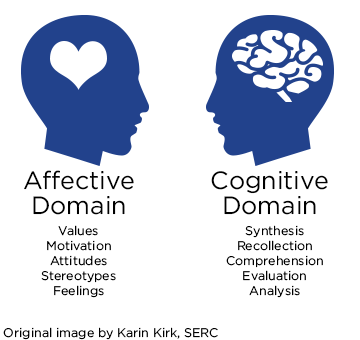
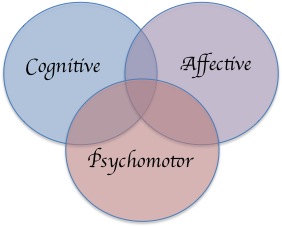
The affective domain deals with attitudes in the classroom and beyond. The basic stages are receiving phenomena, responding to phenomena, valuing, organization and internalizing values. Students move from selected attention (receiving) to active participation (responding), to valuing the worth of a person or object (valuing) to organizing values into priorities by contrasting different values (organizing) and finally to adopting a value system that controls their behavior (internalizing). These steps are very important for the proper development of children and therefore need to be practiced in the classroom and woven into classroom activities such as: creating social plans to improve society, exercising safety rules and displaying appropriate teamwork.
The psychomotor domain are tied to skill based responses with the steps (ranging from lowest to highest): perception, set, guided response, mechanism, complex or overt response, adaptation and origination. This type of learning is demonstrated by physical skills to include both fine and gross motor skills. When students start at the bottom of the taxonomy, they are making observations about a particular task, such as watching someone perform a gymnastics routine and move through the continuum, until they are eventually, through practice, are able to create a new gymnastics routine in the origination stage of the taxonomy. Psychomotor skills are important in the classroom, because these skills also include the ability to use technology, which is a very large theme in the classroom. Psychomotor skills should also be incorporated into lesson in order to incorporate the tactile or kinesthetic learning style into lessons.
The affective and psychomotor domain should be included into the classroom environment in order to cover the knowledge based, attitudinal based and skills based taxonomies in order to create a complete learning experience.
Subscribe to:
Comments (Atom)