Tübingen Germany

Tübingen Germany

Friday, September 19, 2014

How are Tests the Answer?- 9/26/14

Upon reading the first few chapters of "The Smartest Kids in the World and How They Got that Way" by Amanda Ripley, the thought occurred to me, that tests, no matter what form, are seen as the solution to the educational woes across the world.
(image: google images) 
The first chapter of this book launches into a discussion of the beginning of the PISA or Program for International Student Assessment. The PISA is designed to measure student creative thinking and problem solving skills, but not in a mathematical problem solving way, but more of a real-life application of creative and critical thinking. 

In a country, where so much of the system is based upon standardized test scores, how could another test be the solution to this problem of "teaching to the test" and No Child Left Behind? Tests could be seen by many as the solution to an educational problem, because this is what the educational community has always done. But is it not time for a change? Students should be learning how to think critically and creatively but not because a test tells us so. This calls for a change in the type of assessment given. 

As a future teacher of a foreign language, it is stressed that students be given authentic assessment, or assessment that mimics real-life situations, such as preparing a dialogue that one could use to order food in a foreign country, or writing directions to give to a fellow student who can only speak in the target language. This type of assessment should be integrated into all class disciplines. Rather than giving a multiple choice test, students should be using their knowledge to decipher real-life scenarios, such as mortgage applications, figuring out the best long term financial plan and so on. Do we really need a test to tell us that our students need to think more critically and on a higher level. I personally do not think so. 

Wednesday, September 17, 2014

Unknown Domains of Bloom's Taxonomy- 9/15/14

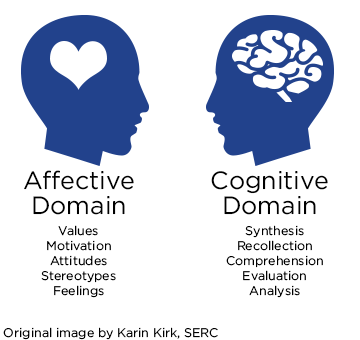
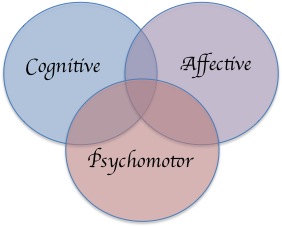
Bloom's Taxonomy is the basis of many objectives used in the classroom, which are set through the cognitive levels. These levels began (from lowest to highest): knowledge, comprehension, application, analysis, synthesis and evaluation, then later were turned into action verbs to include: remembering, understanding, applying, analyzing, evaluating and creating. This taxonomy is used throughout the classroom through objectives and as the basis for activities in order to promote higher level thinking. Bloom's cognitive domain taxonomy is well-known and well-used throughout the classroom, however there are actually two other taxonomies, the affective domain and the psychomotor domain that come into play in the classroom.

The affective domain deals with attitudes in the classroom and beyond. The basic stages are receiving phenomena, responding to phenomena, valuing, organization and internalizing values. Students move from selected attention (receiving) to active participation (responding), to valuing the worth of a person or object (valuing) to organizing values into priorities by contrasting different values (organizing) and finally to adopting a value system that controls their behavior (internalizing). These steps are very important for the proper development of children and therefore need to be practiced in the classroom and woven into classroom activities such as: creating social plans to improve society, exercising safety rules and displaying appropriate teamwork. 

The psychomotor domain are tied to skill based responses with the steps (ranging from lowest to highest): perception, set, guided response, mechanism, complex or overt response, adaptation and origination. This type of learning is demonstrated by physical skills to include both fine and gross motor skills. When students start at the bottom of the taxonomy, they are making observations about a particular task, such as watching someone perform a gymnastics routine and move through the continuum, until they are eventually, through practice, are able to create a new gymnastics routine in the origination stage of the taxonomy. Psychomotor skills are important in the classroom, because these skills also include the ability to use technology, which is a very large theme in the classroom. Psychomotor skills should also be incorporated into lesson in order to incorporate the tactile or kinesthetic learning style into lessons. 

The affective and psychomotor domain should be included into the classroom environment in order to cover the knowledge based, attitudinal based and skills based taxonomies in order to create a complete learning experience.